Guides › Reading clues: plates, legends, symbols and notes
Reading clues: plates, legends, symbols and notes
Published October 16, 2026.
Almost every mechanism is solved with information found elsewhere on the box. That information is never written plainly: you have to read it, count it, translate it or calculate it. Here are the most common families of clues and how to approach them.
Roman numerals
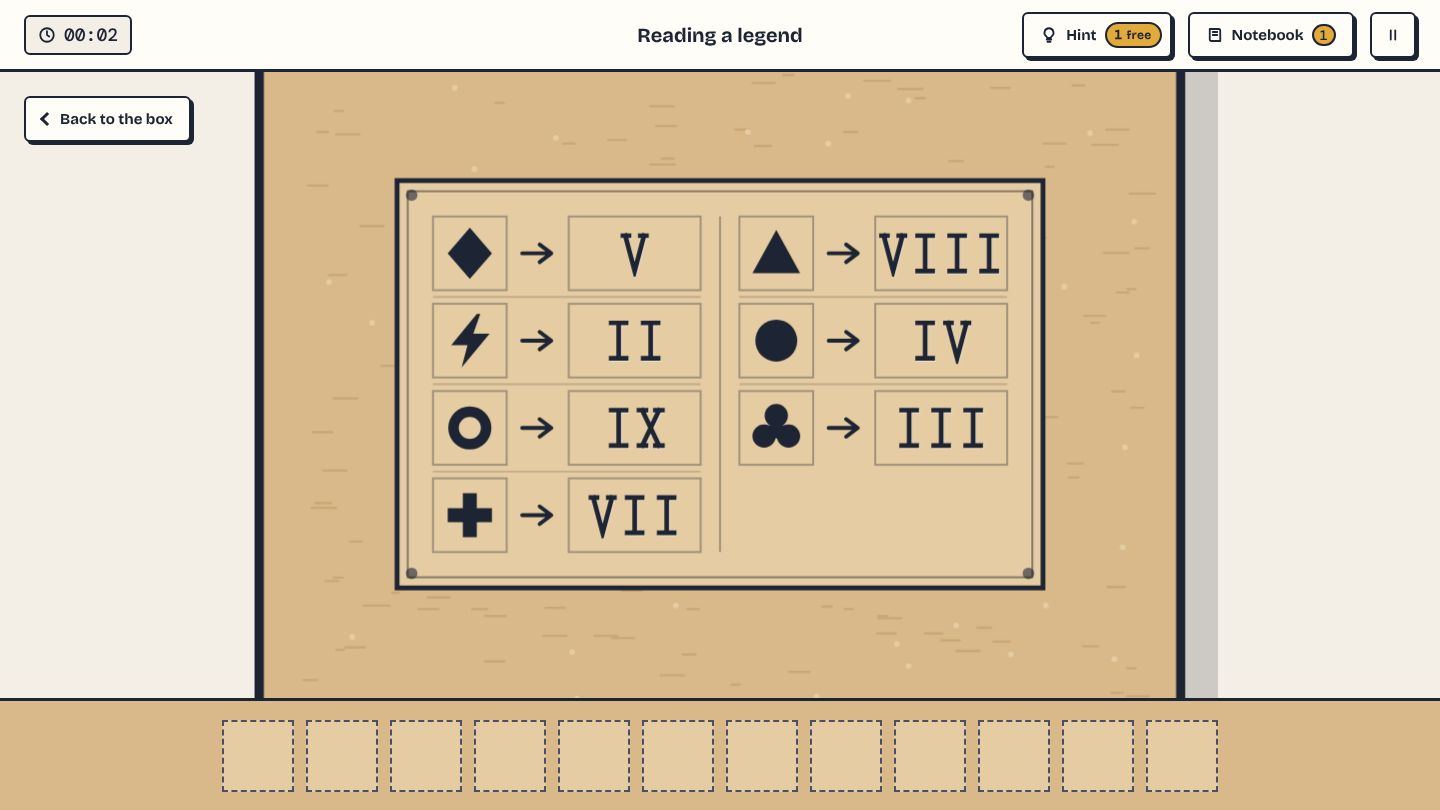
A code is sometimes engraved in Roman numerals, from I to IX, since codes only use digits from 1 to 9. Blinking lamps also use these glyphs to show a rank. If Roman numerals are not familiar, remember that IV is 4 (one less than V), IX is 9, and that letters are read left to right and added up, except when a small numeral comes before a larger one.
Symbol legends
When a code is written in symbols, a legend says which digit hides behind each one. Translate them one by one, in order. Beware of decoys: a legend may contain extra pairs, symbols unrelated to the plates. Only those that appear on the plates count. Write the translation in the notebook before moving to the mechanism, so you do not lose it while turning the box.
Counting questions
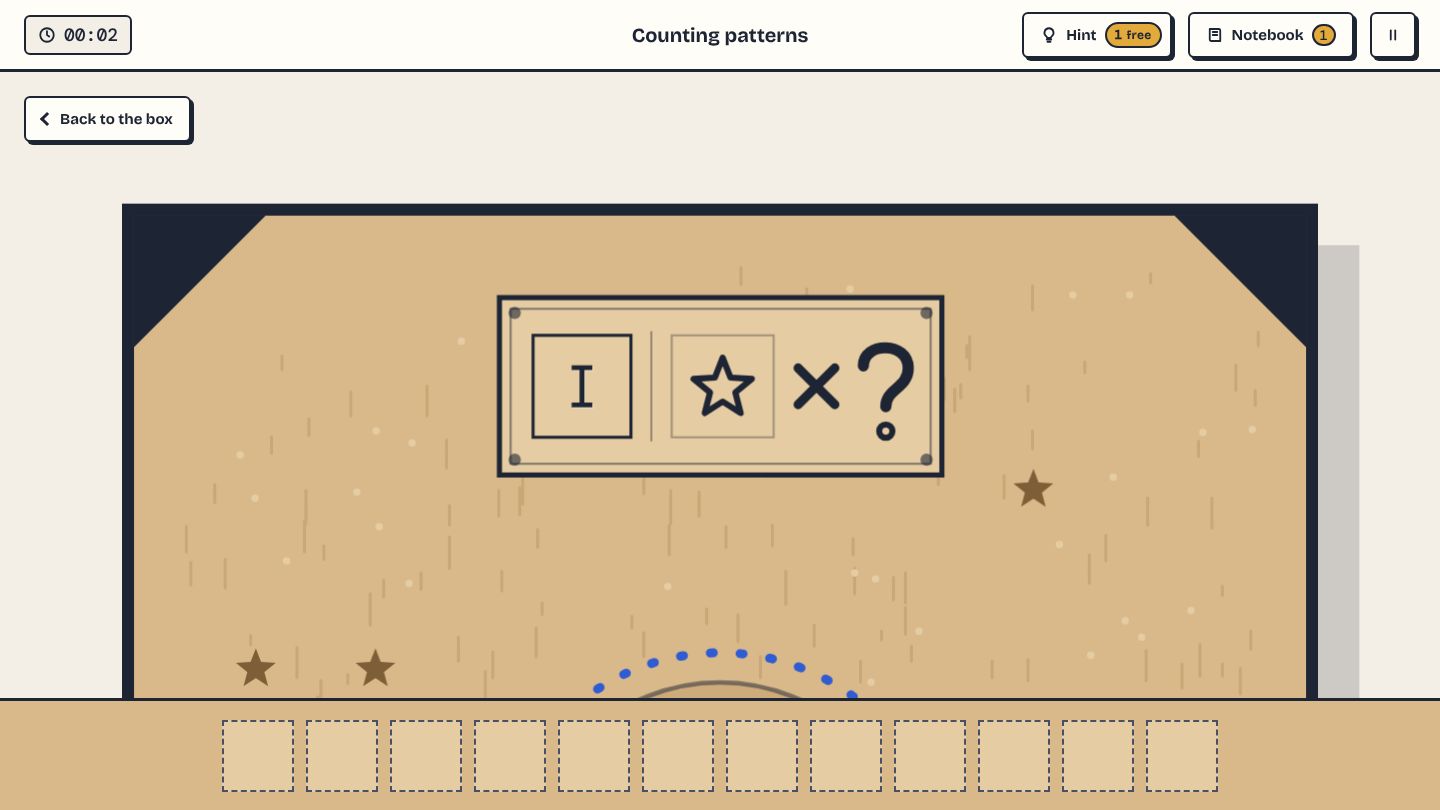
Some plates ask questions: how many patterns of a given kind are on a given face? The number you find is a digit of the code. There are one to nine patterns per face. Count twice, face by face, and beware of patterns that look alike but are different: a five-pointed star is not a six-pointed star. A theme's decoration is never counted: only the symbol patterns in play count.
Sums and statements
A plate may be a small calculation whose result is a digit of the code. Other clues are statements about order or position, such as « the round symbol comes before the star ». Each statement rules out possibilities: try each place and eliminate what contradicts. Position statements (« in third place ») pin elements down and unlock the rest.
Engraved surfaces, the magnifier and the grid
An engraved surface only gives up its symbols with a magnifying glass: assemble it if it comes in two pieces, place it on the surface and move it all over. A grid with holes is laid on a plate: only the cells seen through the holes count, and only one of the four orientations of the sheet gives a readable code. The grid may carry an orientation mark: use it.
Plates that only light up for a moment
A timer can reveal a plate for a few seconds. If the information is too long to remember, write it down as soon as it appears, or restart the timer: it is free and as many times as you want.
A rule of thumb
A plate that seems useless almost always is useful, unless it is a decoy. When in doubt, write it in the notebook and carry on: if it matches nothing once you have solved the other modules, it was a decoy.
Practise in the game
The game's tutorials, with no clock and no penalty, let you practise this subject: