Guides › Getting started: how to approach a puzzle box
Getting started: how to approach a puzzle box
Published October 16, 2026.
A Daily Box puzzle is a small closed object with six faces, hiding a chain of mechanisms. Each mechanism unlocks the next, up to the final lock. The goal: open it as fast as you can, with as few mistakes and hints as possible.
Walk around the box first
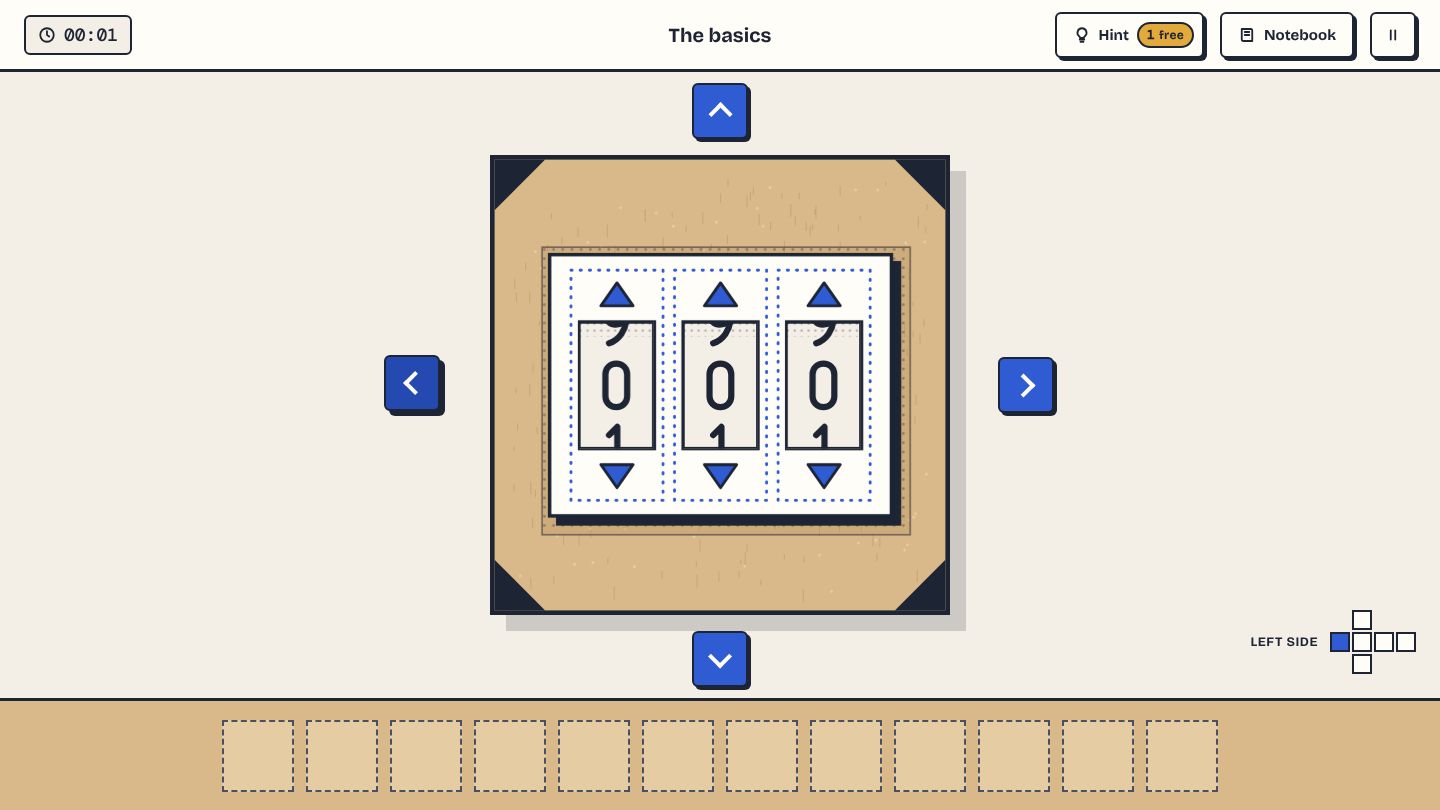
Before touching anything, turn the box to see its six faces: with the arrows around the box, or by dragging it. The net at the bottom right of the scene shows the face you are looking at and lets you jump straight to another one. This first look takes a minute and saves you from going over the same face ten times.
Spot what looks like a mechanism (dials, keys, drawer, scales, levers) and what looks like a clue (engraved plates, symbols, lamps, legends). A clue is rarely on the face of the mechanism it is about: the information is deliberately spread out.
Zoom in, then come back
A click on a mechanism or a clue opens it in a close-up that is much easier to read. A click beside it, or the back button, takes you back to the whole box. The whole surface of a mechanism opens the close-up, not just its moving parts: when in doubt, click.
Pick up, place, take back
The objects you find (keys, tokens, coins, weights, gears) go to the inventory at the bottom of the screen and stay there until you use them. To use one, drag it onto the mechanism that is waiting for it. Good news: placing an object in the wrong spot is never a mistake, and a placed object can be taken back as long as its mechanism is not solved. Try freely.
No action can make a box impossible to open. You can always go back and try again.
The notebook is your friend
The notebook keeps the notes and symbols you have seen. Open it to compare a clue seen on one face with a mechanism on another. Opening it does not stop the clock, but it costs nothing either: it saves time for those who use it.
Message fragments, for their part, are spread across several modules: a single fragment is almost never enough.
What costs time, and what does not
Only one thing is a mistake: a failed attempt at a code (a drawer pulled too early, wrong panels, a wrong key). It adds 15 seconds, never more. Codes only use digits from 1 to 9, even though the dials also show 0.
Pulling the drawer counts as an attempt: enter the whole code before pulling, not to see whether it works.
Boxes inside boxes
Some boxes contain others, always in a chain: one box inside the previous one. Each is solved with what it contains: everything you need to open it is in that box. Only the magnifying glass, which is never used up, can serve in the following boxes. A box only opens once you have taken what was useful inside it.
Practise in the game
The game's tutorials, with no clock and no penalty, let you practise this subject: