Guides › Timers, hold buttons and blinking lamps
Timers, hold buttons and blinking lamps
Published October 16, 2026.
Some boxes ask for patience, rhythm or memory. These mechanisms involve time, but they require no reflexes: you can always try again.
The timer: a plate lit for a moment
Pull the timer's lever: a plate lights up for a moment, long enough to read it. You can restart it as many times as you like, at no cost. It can take the form of a lever, an hourglass or a gauge (whose crank adds time with each turn). The dial that shows the remaining time may be on another face.
Write down at once what the plate shows, or get the notebook ready before you start: it is faster than restarting several times.
The hold button
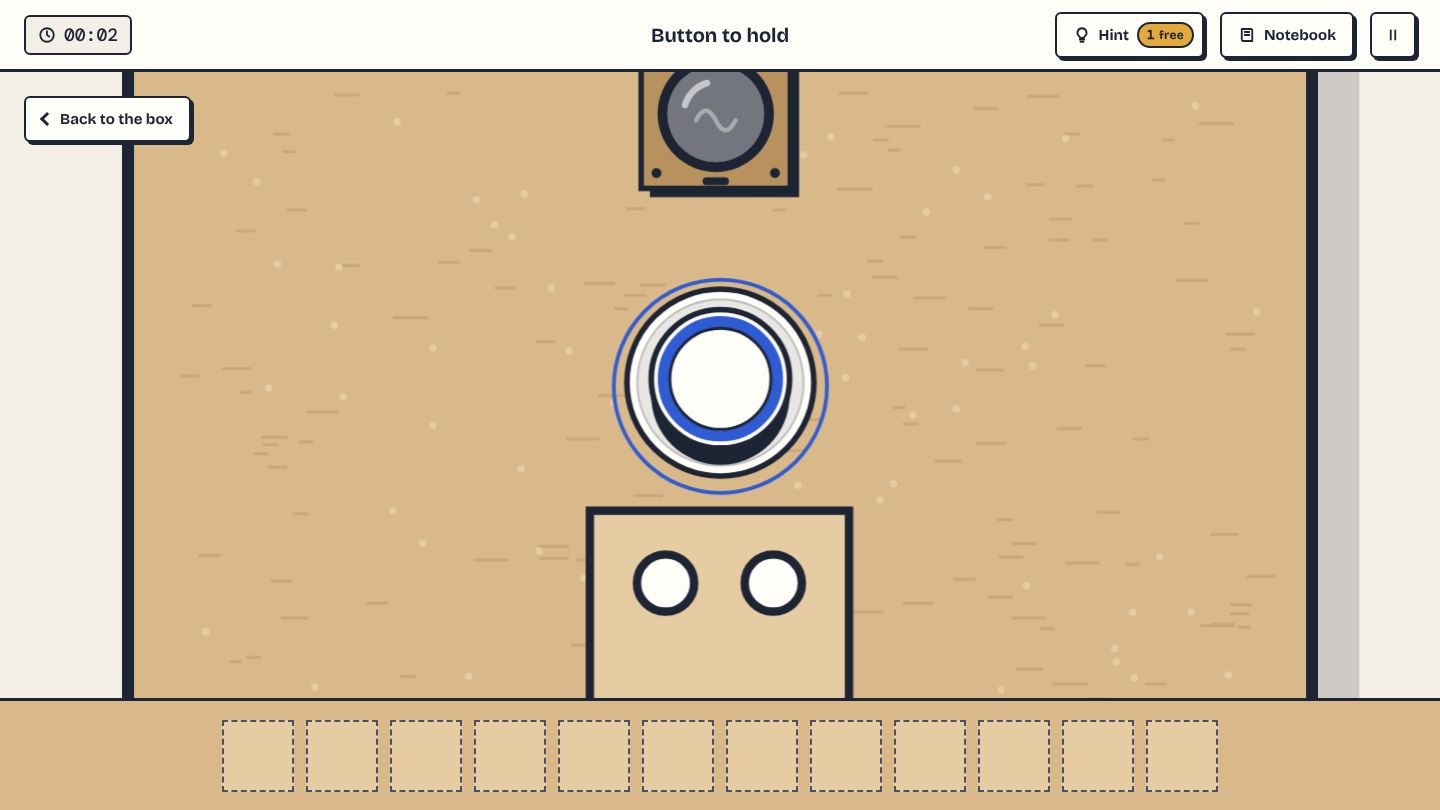
Keep the button pressed: a lamp lights up every second. In the simplest mode, you only need to hold until the last lamp, after which the button releases by itself. Releasing earlier is not a mistake. A simple click of less than 0.6 seconds is never penalised either.
In harder modes, you must release within a window marked under the row of lamps, between the indicated lamp and the next one. Several buttons may follow one another: each is held then released in its own window, in the order given by the plate. In these modes, releasing at the wrong moment is a failed attempt, which costs 15 seconds.
Blinking lamps
A blinking lamp gives a digit: you just count the flashes. Each digit of the code has its lamp, placed as close as possible to what it concerns (above its button or its dial). When that is not possible, its rank is shown in Roman numerals under the lamp. Count out loud and do it again: one missed flash spoils everything.
The notebook does not stop the clock, and it does not stop the timers either: consult it while you play.
Practise in the game
The game's tutorials, with no clock and no penalty, let you practise this subject: