Guides › Gears, cranks and gauges
Gears, cranks and gauges
Published October 16, 2026.
These mechanisms are about movement: you turn, you place wheels, you measure. A little mechanics is enough to solve them.
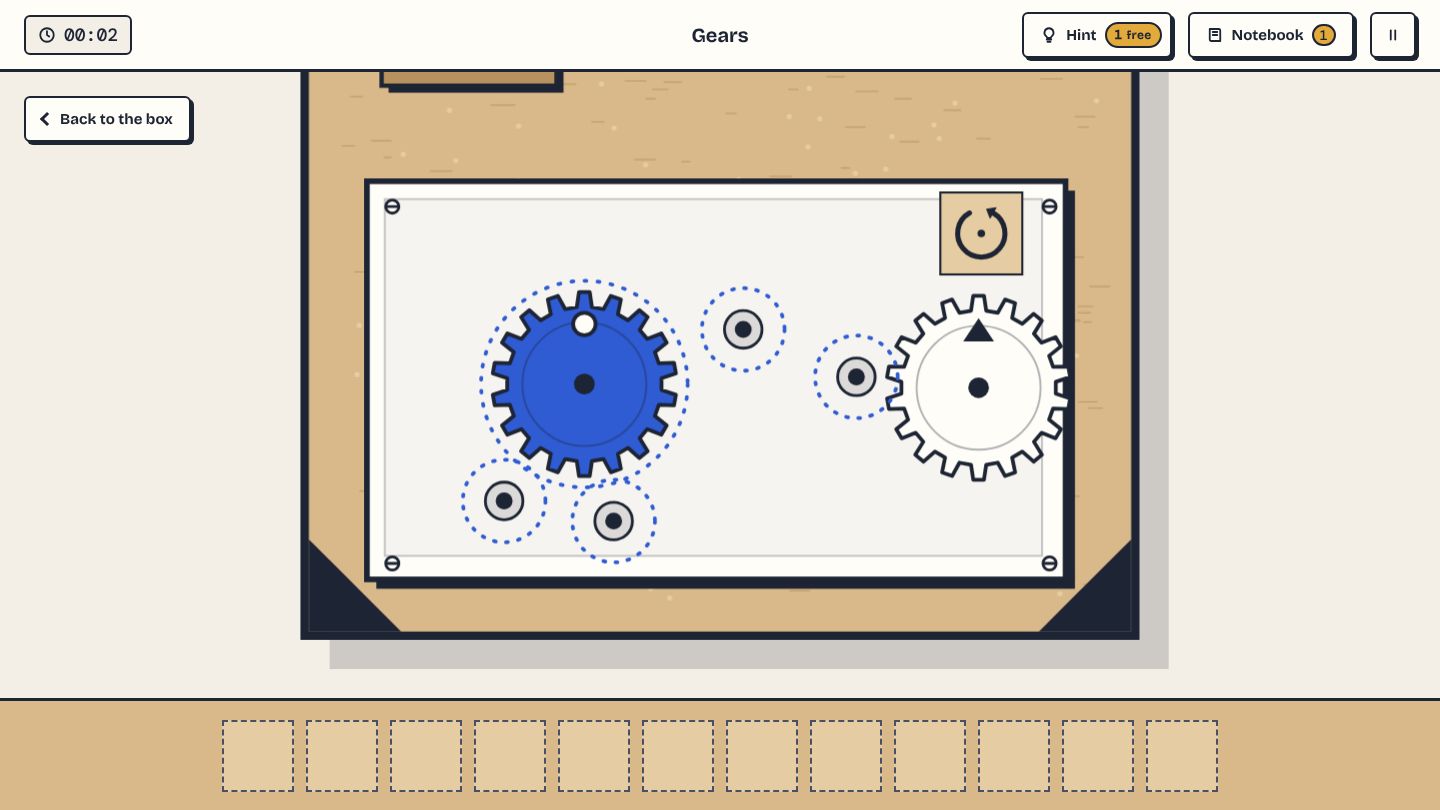
Gears: where does each wheel go?
Place each wheel on the axle where its teeth meet those of its neighbours exactly, neither too close nor too far. A wheel that fits nowhere is a decoy. Placing a wheel whose teeth overlap another one is refused, with no penalty: try the different axles.
Then turn the driving wheel clockwise: the output must turn in the requested direction.
The rule of directions
Two meshing wheels turn in opposite directions. In a simple chain of wheels, the output therefore turns in the same direction as the driving wheel if the number of wheels is odd, and in the opposite direction if it is even. If the chain forms a loop with an odd number of wheels, it jams: no movement is possible, and nothing is penalised.
Only the wrong direction of the output, at the end of the crank, is a 15-second mistake. A broken chain or a jam is not.
The crank
First put the crank on its axle (it is in the inventory). Then turn it in a circle, several turns in a row. Some cranks require an exact number of turns, given by a clue: count them carefully.
The gauge
A level indicator, the gauge, rises when you turn the crank: the level to reach is given by the clue. Read the requested level carefully before turning: every extra turn is lost time. A gauge can also drive a timer: each turn adds time during which a plate stays lit.
A habit: test in your head
Before turning the driving wheel, count the wheels in the chain that leads to the output and apply the parity rule: you will know which way the output will turn without trying anything. If that direction is not the requested one, the chain is not the right one: another wheel from the inventory, placed on another axle, changes the length of the chain.
Wheels of different sizes have no other effect here than meshing or not: only the distance between axles decides whether a wheel fits.
Practise in the game
The game's tutorials, with no clock and no penalty, let you practise this subject: